Andrej Karpathy, computer scientist, AI educator, OpenAI founding member, and former Senior Director of AI at Tesla, put words to something many engineers are quietly feeling right now.
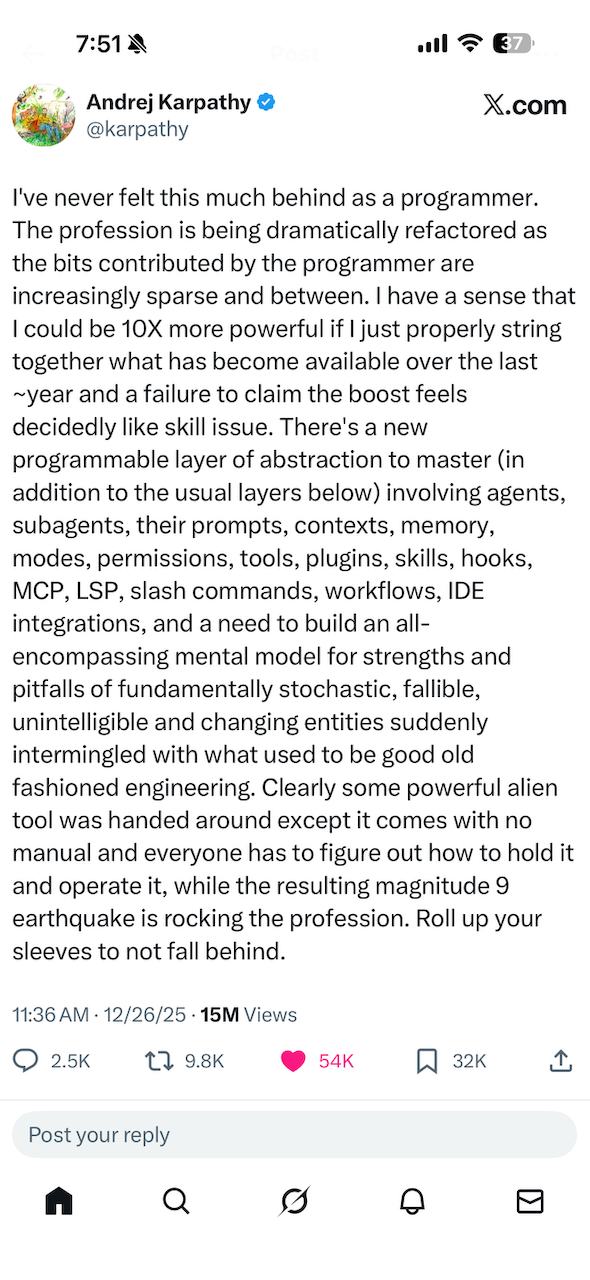
He says he's never felt more behind as a programmer, yet believes he could be 10x more productive if he fully leveraged what's emerged over the past year. Not doing so, in his words, starts to look like a skill issue.
That tension is the moment we're in.
A New Layer of Abstraction
The profession isn't just adding new tools. It's absorbing a new layer of abstraction: agents, prompts, context, memory, MCP, and workflows. Engineers now have to build intuition for systems that are inherently stochastic and fallible, operating alongside the deterministic engineering many of us grew up on.
His metaphor lands hard. We've been handed a powerful alien tool with no manual, and we're all learning how to use it in real time.
His advice is simple: roll up your sleeves to not fall behind.
That resonates.
Rolling Up My Sleeves
Between exploring Claude Code, Cursor, Kiro, and MCP-driven integrations, I'm firmly in the roll-up-your-sleeves camp. Much of my recent thinking and writing reflects this shift, from treating AI as a feature to designing agentic workflows that change how work actually gets done.
This isn't about abandoning good engineering.
It's about recognizing that the leverage has moved up the stack.
The Question
So here's the question I'm wrestling with.
Which parts of this new layer are you deliberately investing in learning, and which are you choosing to ignore for now?
Originally shared on LinkedIn